While the romance of ‘Beetlejuice Beetlejuice’ was less “strange and unusual” than I imagined, it succeeds as a charming, female-led comedy.
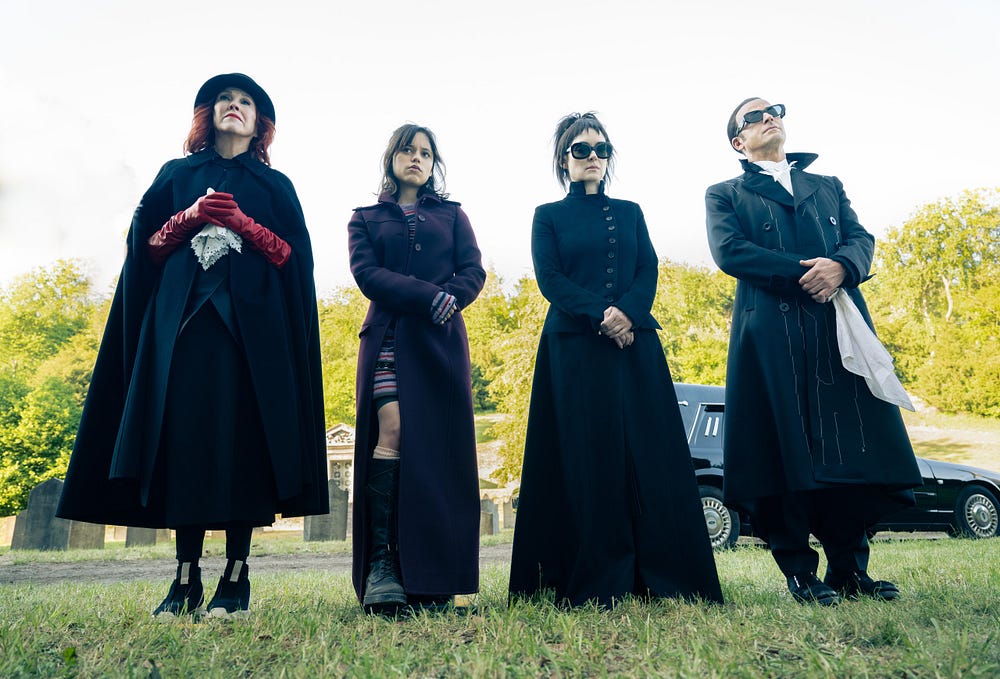
I spent most of my time looking forward to Beetlejuice Beetlejuice as a Jenna Ortega fan rather than anything else, making me one of the 25% of people going apparently just to see her and Winona Ryder together, and I’m not ashamed to admit that! At the time that I’m writing this, I just got back from seeing this movie for a second time. Honestly, after my first viewing, I wasn’t a huge fan, but upon watching with fresh eyes, I feel like I see it in a whole new light.
As a warning, this article will contain some minor spoilers for Beetlejuice Beetlejuice.
I honestly think it just took some getting used to; the main thing that surprised me was actually how much more heterosexual the movie was than I had imagined. I hadn’t gone in expecting an overtly queer love story or anything but rather something lacking in romance entirely. While none of the romance in this movie amounted to anything good for the characters involved, there was, frankly, a lot of it. It felt a bit jarring compared to the gothic, campy, otherworldly aesthetic of the movie, which to me feels almost inherently queer — it’s outside of the norms in this big, boisterous, unabashed way.
It feels like these films, Beetlejuice included, have gained cult followings within the queer community because they feature characters who are unapologetically “strange and unusual” and proud of who they are. This phenomenon made the movie’s fascination with traditional heterosexual-romance-gone-wrong all the more shocking for me to watch for the first time, but after some thought, I feel like it really fits with what Tim Burton’s stories tend to be about.
Beetlejuice, like The Addams Family, always seemed to me like it was about the demolition and then restructuring of the nuclear family. The Addams Family twists the nuclear family on its head: a husband and wife can be truly in love, a daughter can be morbid and stand up for herself, there need not be tension between a mother and her daughter, and they can do all of these healthy behaviors while all the while being goth, morbid outsiders. In Beetlejuice, Lydia literally redefines her family after the loss of her mother, -finding additional (albeit temporary) parental figures in the Maitlands and ending up in a very nontraditional family structure.
By the time this legacy sequel rolls around, Lydia (Winona Ryder), Delia (Catherine O’Hara), and Astrid (Jenna Ortega) are a family that, as the movie itself cites, doesn’t have a leading male figure. Together, the three women are able to defend and support each other when faced with men trying to impede on the family unit with not-so-good intentions. Even in Lydia’s dream sequence, Astrid’s marriage to a man ends up in disaster when her baby comes out a monstrous version of Beetlejuice (Michael Keaton).
In that way, though the movie contains multiple male leading characters and love interests, it seems to be more focused on rejecting the centering of men in stories about family, or, more specifically, rejecting the idea that there needs to be a man present for a group to be considered a family. I do think the idea falls in on itself a little bit since the way it is told is so male-reliant, but the point made is not uninteresting.
The first time I watched it, I was a bit too put off by the romance to enjoy the payoff, especially because I think the justice was a bit too underdone for some of these characters (Rory [Justin Theroux] deserved worse than a sandworm)! It’s the same issue that often pops up in other horror movies; they spend so long building up hatred and dislike for a character to build anticipation toward their eventual death that when the death comes along, it’s underwhelming.
Beyond this, upon second watch, I believe there’s something very joyful about it about this film. Reflecting on it further, I realized that Beetlejuice Beetlejuice fits into a gap that’s often missing in Hollywood — women-centered blockbusters that don’t revolve around pain or trauma or specifically romantic happy endings. While movies like Barbie and Frozen 2 have been hugely successful, they often address women’s suffering, whether through societal expectations or emotional turmoil. There’s certainly value in that, but it’s also refreshing to see a film that lets women lead in a more lighthearted, popcorn-movie way, without feeling weighed down by gender politics. The humor itself felt designed for women, especially in the way it pokes fun at male arrogance and victimhood.
Rory, for instance, had a shtick of constantly using therapy speak, and this is something that I’ve personally experienced that a lot of men do: overuse that kind of talk to manipulate situations or paint themselves as the victim. Sabrina Carpenter even referenced this in one of her new songs, Dumb & Poetic: “Every self-help book, you’ve already read it / Cherry-pick lines like they’re words you invented”. The movie went so far as to play on the same bit as Greta Gerwig’s Barbie with Ken’s “I’ll play the guitar at you.”
So, sure, maybe it wasn’t as sapphic in the Bechdel-test way of looking at it, but I can admit that I was wrong to write it off so harshly initially. Even beyond my thoughts about feminism and queerness, I think it’s rare that we get such a strange blockbuster movie killing it in the box office like this, and that’s something that I always must appreciate. It was whimsical and full of life, and I don’t think I’ve seen a big-budget movie as fun, unapologetic, and unique in recent memory.
Something that I loved most upon rewatching is how committed the movie was to every comedic bit. In fact, at many points, it seems that it didn’t even care so much about the plot and the storylines but rather swerving in wild directions and hitting on every joke and visual gag they could until the credits rolled, and it was very successful. Catherine O’Hara as Delia probably made me laugh more than I’ve laughed at all the other movies I’ve watched this year combined (granted, I am a horror fan), and I’m sure everyone in the audience would agree based on how loud they were after almost every word that came out of her mouth!
A lot of the jokes in this movie also reminded me a bit of Deadpool, but I enjoyed them more because they were just a bit more subtle; that is to say that the joke was obvious, but the narrator didn’t hold my hand and walk me through it (for example: Willem DaFoe’s Wolf Jackson is certainly not “keeping it real” when all of his dialogue is read off of cue cards from his assistant). There’s a bit of trust in the audience to get it, and when they do, it feels much more satisfying than if it had been given to me on a silver platter. Also unlike Deadpool, I found the callbacks to be really tasteful and not too heavy-handed.
I’ve never been a huge fan of comedies because I feel like they’re never able to toe that line between being silly and scary, but Beetlejuice Beetlejuice really succeeded there. Even when the stakes were high, there was still a sense of joy, heart, and humor throughout, and many of the visual gags were things that would typically be considered horror effects: eyes literally popping out of someone’s head, someone’s guts falling out, and more. One character’s whole bit was that their head was bitten off by a shark, it was played for laughs over and over and over, and it was funny every time! The practical effects really shined, and the style just came across as so well-polished — Beetlejuice Beetlejuice has its own aesthetic that is perfectly consistent, and every bizarre moment fits right in.
There were some sequences that, in any other movie, might have felt out of place, like the Claymation bit when they talk about the death of Lydia’s father, or the black-and-white scene when Beetlejuice recounts his marriage to Dolores. But here, those moments just worked. The film found creative ways to deliver exposition and storylines without feeling like it was dumping information on the audience. Even though there were a lot of storylines, I never felt lost. Some of these storylines might have tied up a little too cleanly at the end, but in a way, I feel like that kind of deus ex machina is typical of traditional comedy, and it comes across as almost part of the charm.
When I watched it the first time, it felt messy. But on the second watch, I realized that’s kind of the point — it’s meant to be funny and silly, and there’s a joy in that. The filmmakers clearly love this story and poured all their talent into it, and that energy shines through in the final product. I think it’s rare to see a movie that’s just plain fun like this these days, so be sure to check it out if you can!
★★★★☆
7.6 out of 10
Check out Beetlejuice Beetlejuice in theaters now.


No comments:
Post a Comment