Friday, September 27, 2024

'#AMFAD: All My Friends Are Dead,' 'Tarot,' and the Pitfalls of Gimmick Horror

Horror would be nothing without gimmicks, but they don't have to come at the expense of meaningful storytelling.

Despite the totally different tones and style of the movie, my first thought when watching #AMFAD: All My Friends Are Dead was that it reminded me of another 2024 release: Tarot. At a glance, these movies have next to nothing in common. #AMFAD is a true-to-form R-rated slasher, advertising its gore and Jojo Siwa’s involvement to bring in an audience, while Tarot’s draw was due to the monster designs made for each tarot card featured in the PG-13 movie.  However, both films share one fundamental similarity: their reliance on gimmicks to keep the audience hooked. 

#AMFAD is basically all gimmick: a killer wearing the face of a dead ex-friend kills our unlucky (or maybe just awful) group of social media influencers based on which of the seven sins they most embody. The executions are creative but absurdly on-the-nose, like when Guy (Jack Doupe-Smith), the group’s designated “glutton,” is force-fed until his stomach explodes. While Tarot makes a (poor) attempt at storytelling on top of its gimmick, the centerpiece of the film is clearly the titular tarot cards. Haley (Harriet Slater) does readings for each of her friends, and they all begin to die in ways earlier similar to the fortunes she predicted. For one of her friends, for instance, she draws the High Priestess and tells them that they are “climbing the ladder of success” but will later suffer a “crushing blow”; the friend is later bludgeoned by a ladder by a monstrous version of priestess.

While watching #AMFAD for the first time, I found that these movies both succeeded and failed in a lot of the same places. For both, the creative kills are a major standout element. They are, of course, contrived and outrageous, but the tone of each film allows for that. #AMFAD is silly and ridiculous all the way through, and Tarot is clearly in the realm of the fantastical; it’s easy to suspend your disbelief and just enjoy the madness of what’s going on. The kills are aided with great props and set pieces in #AMFAD and awesome effects and creature designs in Tarot. In a way, it makes sense that the kills are the highlight: they are clearly what the selling point was of the movie and the reason it was written in the first place. These visual elements, while effective, ultimately highlight the movies’ biggest flaw: the gimmick is all they have.

Not one member of #AMFAD’s cast of social media influencers develops even the slightest bit as the story progresses. The characters are rude, vapid, stupid, and then they die. The only character who ends the story in a different light than she first started is the protagonist, Sarah (Jade Pettyjohn), but that is just because her backstory is meant to be a twist ending where she had been the one behind the killings. Even this “twist” is uninteresting because there is no other believable reason for her to be involved in the hangout unless she was planning the killings. At the end of the day, no one grows or changes, and the characters constantly show how little they care about each other. Despite being a slasher where the viewer is meant to gain some sort of affection for the final girl and last few survivors, the characters are instead written like meat fodder for a Saw movie: people who have already committed some grave wrongdoing and are simply awaiting their punishment like lamb to the slaughter.

Tarot’s characters don’t even have the excuse of being fake, uncaring social media influencers to explain why none of them seem to care about their friends dying. Haley is the only protagonist given any kind of emotional arc and backstory, and it does little more than to make her character come across as melodramatic compared to the others involved in the events taking place. Of course, meat fodder is a necessity in any kind of slasher-esque movie, but characters like Paxton (Jacob Batalon) and Paige (Avantika) probably could have gotten a little more depth of personality other than “funny” and “sad” since they both lived through most of the movie.

Both movies also fail to add anything of substance to their initial gimmick. In the case of #AMFAD, I honestly struggled to see why many of them were assigned their deadly sin. Liv (Ali Fumiko Whitney) was given the sin of “greed” because she wanted followers on social media, but out of all of her friends, she seemed to be the least cutthroat one there and wasn’t really doing much in terms of stepping on others to achieve fame. Mona (Jennifer Ens) was given “pride,” but in all honesty, greed would have been a better fit for her. Pride is usually about having an excessively high opinion of oneself, but Mona seemed to have the genuine capabilities, strength, and talent to back up all of her claims. Sure, she was mean to others, but her high self opinion seemed to have a pretty valid source. Beyond that, they seemed to forget about this whole theme in the third act, where the characters were mostly dying randomly in a chase scene with the killer.

Many people claimed that Tarot was also a complete misrepresentation of what tarot and tarot readings actually are. They created some really cool-looking monsters to match with each card, but it seems clear that they didn’t care much to look into what people actually use tarot cards for and how they work. For example, people who use tarot cards know that the future is not some fixed thing but rather something that will change and grow based on our actions. Despite this fact, one of the only characters to truly survive their death trap was Paxton, and he only lived because his roommate happened to open the elevator door at just the right moment, something that was completely unrelated to his fortune. This change would maybe imply that our futures aren’t fixed, but that only some external force can change them, which seems counterintuitive to tarot’s real purpose of self-reflection and growth. If #AMFAD wanted to be Saw, then Tarot definitely was following in Final Destination’s footsteps.

What’s surprising, though, is how these gimmicky slashers manage to showcase some genuinely strong performances. Avantika, for instance, was wonderful in Tarot; she was the only one who ever sounded truly upset in scenes where the characters were mourning their lost loved ones, and her death scene at the hands of the Magician was my favorite in the film, doubtlessly because of how her believable reactions and emotions elevated the tension. Similarly, Jennifer Ens stands out in #AMFAD as Mona, the tough-as-nails influencer who believes she deserves to survive at any cost. Her confidence and fierce attitude make her one of the more memorable parts of the film, even if the writing around her character is weak.

At the end of the day, what feels unfortunate to me is that both #AMFAD and Tarot squander the potential of both their gimmicks and, at times, their passionate and talented cast and crew. Gimmick horror is a staple to the genre. Where would we be without Final Destination 2 terrifying everyone into switching lanes when they’re driving behind a logging truck, the possibility of a Happy Death Day/Freaky crossover, or Unfriended’s completely online storytelling? Many of these movies manage to be entertaining, have great kills, and tell a real story all at once. Movies like Scream and Cabin in the Woods show that even self-aware, trope-laden horror that’s literally making fun of itself can still have thematic depth. #AMFAD and Tarot, however, don’t ever move beyond surface-level scares. By focusing so intently on their kill mechanics and neglecting character arcs, they lose the opportunity to make their deaths feel earned or meaningful.

If you’re in it for the kill count or a fun, mindless watch, then both #AMFAD and Tarot will probably entertain. But for those hoping for a slasher with real substance, these movies may leave you wanting more. 

Thursday, September 19, 2024

‘Red Rooms’ Lives in the Space Between Observation and Obsession

Red Rooms tackles the perils of parasocial relationships and serial-killer fanaticism with an icky yet invasive fascination.

Red Rooms was one of the biggest surprises of the year for me. Since I had heard good things about it online, I went out of my way to check it out at a local theater, and it was definitely worth the extra effort! It immediately flew up my ranked list of new releases from the year to a spot in the top three.


The movie follows model/online gambler/hacker Kelly-Anne as she attends the trial of Ludovic Chevalier, a man being charged with recording and posting snuff films online of the murder of three young girls between the ages of 13 and 17. While I believe this phrase tends to be a bit hyperbolic when it comes to movies and only leads to disappointment: at no point in this film will you ever be able to tell what is coming next.


This article will discuss spoilers for the movie, so if you haven’t seen it yet, I would recommend going in blind so you can experience the same sickly nightmare of a time that I did.


Red Rooms resonated with me as a perversion of the detective archetype in classic mystery stories. Kelly-Anne has the same emotional detachment and specialized intellect as a Sherlockian detective. She focuses on something and cannot get it out of her mind until it is complete, and she does not seem to have any regard for how she makes the people around her feel during the process; hurting them is part of her game, just like the online poker rooms she constantly finds herself in. Just like those detectives, she doesn’t desire payment or credit for her work. 


Unlike them, however, she doesn’t possess their codes of ethics; Sherlock may disguise himself in pursuit of a case to gain information, but Kelly-Anne does the same in what seems more like wish fulfillment, a creepy sort of enthusiasm the viewer never sees from her on any other occasion. The detective is thus not necessarily the objective truth teller we typically see: our detective may not be someone we can trust at all, one driven by self-serving desires that we can never understand because she does not allow us or anyone else into her mind.


Perhaps this is why the film's cinematography feels like an exercise in surveillance. As the audience, we are often given the perspective of security cameras wherever Kelly-Anne is. We at least watch her take note of them wherever she goes. When we aren’t given these voyeuristic glances into her life and the lives of people around her or watching the camera move mechanically around a courtroom, we are often focused directly on her face—or, rather, her eyes. Watching and being watched are core tenets of this film and Kelly-Anne as a character. One scene that encapsulates this is a split diopter shot that appears midway through the film; it focuses both on a livestream being projected and the eyes of the person watching it. As viewers, we’re never shown the content of the snuff films, only the characters’ reactions as they play out before them, whether it be tears, passing out, or gleeful celebration.


In a way, Red Rooms explores the ethical values of watching or being watched. Can there be something good about sitting back and watching something bad happen? When you watch a snuff film over and over and over again, is it truly possible that your only motivation was justice, or must there be some level of obsessiveness to it?


This line between obsessiveness and justice seems to be in clear reference to the consumption of true crime content online: fans constantly recount the grisly deaths of real people, try to pick up and solve cases that have gone long cold, and even fall in love with serial killers, and each of these people are called out for their behaviors throughout this movie’s runtime. There is a solid line between voyeurism and justice, and Kelly-Anne spends the whole runtime of the movie toeing it, only swerving one way or the other in a few of the film’s best scenes. The viewer is constantly wondering what her intentions are, and I think the fact that we never really find out makes it even stronger.


In what is possibly the movie’s most disturbing scene, Kelly-Anne quite literally parades around in a costume of a mother’s dead daughter, Camille, puts on her wig and pretends to be her, and even breaks into her bedroom to mimic the pose she did in the very last photo ever taken of her before her brutal murder. Does turning the snuff video over to Camille’s mother absolve her of this, especially when they might have arrested Chevalier anyway? If a young adult goes online and brings up someone else’s dead child, trying to solve a case long abandoned, does this actually help those who survive the victim, or does it just reanimate a corpse that had already been grieved, over and over and over? 


The film's ending is perfectly emblematic of this invasive justice; Camille’s mother wakes up one day to a flash drive that she has never seen before on her nightstand. This flash drive will change her life for the better—it will get her daughter’s killer put in jail—but how did it get here? Who walked up her stairs, through her living room? Who looked over her while she slept? It’s justice, sure, but it is also unquestionably a violation, and this movie forces you to sit in the uncomfortable middle ground throughout its entire runtime.


Another feature of the movie that helps elevate this discomfort is the score. It is oftentimes discordant and, at key moments, terrifying. Toward the beginning of the movie, the prosecutor of Chevalier’s trial discusses how she felt after she first saw the snuff films posted of two of the young girls; she tells the jury how every night, every time she closes her eyes, she is haunted by the images she saw, by their screams. There is one moment in the movie where I’m almost convinced the music intentionally mimicked the sound of this screaming, making the scene something right out of a nightmare.


The cast of the film is also wonderful. Gariépy nails Kelly-Anne’s impassivity terrifyingly well—by the end of the movie, I was nervous and tense just watching her stand there and catch her breath for a few seconds, not knowing what was going to come next, and that’s just a testament to how chilling her performance was—and Laurie Babin’s character Clementine, a fangirl of Chevalier, really brings a sense of charm and whimsy, making Kelly-Anne seem all the more disturbing in comparison.


While other movies have shamed the viewer for watching (i.e. Funny Games as a famous example), Red Rooms serves as more of a warning than anything else about how consuming true crime content or becoming obsessed with real, existing people can be disrespectful if not outright frightening to those around you. Do see it in theaters if you can because the score is something to marvel at.


★★★★★

9.4 out of 10

Check out Red Rooms in theaters.


Monday, September 16, 2024

‘Beetlejuice Beetlejuice’ (Hilariously) Blows Up the Nuclear Family

While the romance of ‘Beetlejuice Beetlejuice’ was less “strange and unusual” than I imagined, it succeeds as a charming, female-led comedy.

I spent most of my time looking forward to Beetlejuice Beetlejuice as a Jenna Ortega fan rather than anything else, making me one of the 25% of people going apparently just to see her and Winona Ryder together, and I’m not ashamed to admit that! At the time that I’m writing this, I just got back from seeing this movie for a second time. Honestly, after my first viewing, I wasn’t a huge fan, but upon watching with fresh eyes, I feel like I see it in a whole new light.

As a warning, this article will contain some minor spoilers for Beetlejuice Beetlejuice.

I honestly think it just took some getting used to; the main thing that surprised me was actually how much more heterosexual the movie was than I had imagined. I hadn’t gone in expecting an overtly queer love story or anything but rather something lacking in romance entirely. While none of the romance in this movie amounted to anything good for the characters involved, there was, frankly, a lot of it. It felt a bit jarring compared to the gothic, campy, otherworldly aesthetic of the movie, which to me feels almost inherently queer — it’s outside of the norms in this big, boisterous, unabashed way.

It feels like these films, Beetlejuice included, have gained cult followings within the queer community because they feature characters who are unapologetically “strange and unusual” and proud of who they are. This phenomenon made the movie’s fascination with traditional heterosexual-romance-gone-wrong all the more shocking for me to watch for the first time, but after some thought, I feel like it really fits with what Tim Burton’s stories tend to be about.

Beetlejuice, like The Addams Family, always seemed to me like it was about the demolition and then restructuring of the nuclear family. The Addams Family twists the nuclear family on its head: a husband and wife can be truly in love, a daughter can be morbid and stand up for herself, there need not be tension between a mother and her daughter, and they can do all of these healthy behaviors while all the while being goth, morbid outsiders. In Beetlejuice, Lydia literally redefines her family after the loss of her mother, -finding additional (albeit temporary) parental figures in the Maitlands and ending up in a very nontraditional family structure.

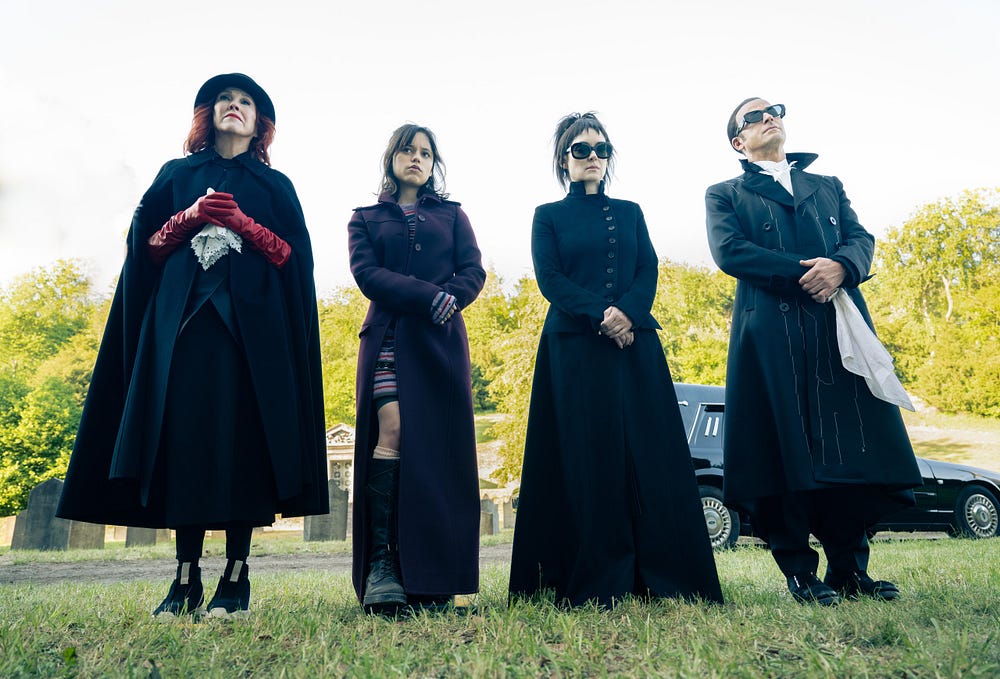
By the time this legacy sequel rolls around, Lydia (Winona Ryder), Delia (Catherine O’Hara), and Astrid (Jenna Ortega) are a family that, as the movie itself cites, doesn’t have a leading male figure. Together, the three women are able to defend and support each other when faced with men trying to impede on the family unit with not-so-good intentions. Even in Lydia’s dream sequence, Astrid’s marriage to a man ends up in disaster when her baby comes out a monstrous version of Beetlejuice (Michael Keaton).

In that way, though the movie contains multiple male leading characters and love interests, it seems to be more focused on rejecting the centering of men in stories about family, or, more specifically, rejecting the idea that there needs to be a man present for a group to be considered a family. I do think the idea falls in on itself a little bit since the way it is told is so male-reliant, but the point made is not uninteresting.

The first time I watched it, I was a bit too put off by the romance to enjoy the payoff, especially because I think the justice was a bit too underdone for some of these characters (Rory [Justin Theroux] deserved worse than a sandworm)! It’s the same issue that often pops up in other horror movies; they spend so long building up hatred and dislike for a character to build anticipation toward their eventual death that when the death comes along, it’s underwhelming.

Beyond this, upon second watch, I believe there’s something very joyful about it about this film. Reflecting on it further, I realized that Beetlejuice Beetlejuice fits into a gap that’s often missing in Hollywood — women-centered blockbusters that don’t revolve around pain or trauma or specifically romantic happy endings. While movies like Barbie and Frozen 2 have been hugely successful, they often address women’s suffering, whether through societal expectations or emotional turmoil. There’s certainly value in that, but it’s also refreshing to see a film that lets women lead in a more lighthearted, popcorn-movie way, without feeling weighed down by gender politics. The humor itself felt designed for women, especially in the way it pokes fun at male arrogance and victimhood.

Rory, for instance, had a shtick of constantly using therapy speak, and this is something that I’ve personally experienced that a lot of men do: overuse that kind of talk to manipulate situations or paint themselves as the victim. Sabrina Carpenter even referenced this in one of her new songs, Dumb & Poetic: “Every self-help book, you’ve already read it / Cherry-pick lines like they’re words you invented”. The movie went so far as to play on the same bit as Greta Gerwig’s Barbie with Ken’s “I’ll play the guitar at you.”

So, sure, maybe it wasn’t as sapphic in the Bechdel-test way of looking at it, but I can admit that I was wrong to write it off so harshly initially. Even beyond my thoughts about feminism and queerness, I think it’s rare that we get such a strange blockbuster movie killing it in the box office like this, and that’s something that I always must appreciate. It was whimsical and full of life, and I don’t think I’ve seen a big-budget movie as fun, unapologetic, and unique in recent memory.

Something that I loved most upon rewatching is how committed the movie was to every comedic bit. In fact, at many points, it seems that it didn’t even care so much about the plot and the storylines but rather swerving in wild directions and hitting on every joke and visual gag they could until the credits rolled, and it was very successful. Catherine O’Hara as Delia probably made me laugh more than I’ve laughed at all the other movies I’ve watched this year combined (granted, I am a horror fan), and I’m sure everyone in the audience would agree based on how loud they were after almost every word that came out of her mouth!

A lot of the jokes in this movie also reminded me a bit of Deadpool, but I enjoyed them more because they were just a bit more subtle; that is to say that the joke was obvious, but the narrator didn’t hold my hand and walk me through it (for example: Willem DaFoe’s Wolf Jackson is certainly not “keeping it real” when all of his dialogue is read off of cue cards from his assistant). There’s a bit of trust in the audience to get it, and when they do, it feels much more satisfying than if it had been given to me on a silver platter. Also unlike Deadpool, I found the callbacks to be really tasteful and not too heavy-handed.

I’ve never been a huge fan of comedies because I feel like they’re never able to toe that line between being silly and scary, but Beetlejuice Beetlejuice really succeeded there. Even when the stakes were high, there was still a sense of joy, heart, and humor throughout, and many of the visual gags were things that would typically be considered horror effects: eyes literally popping out of someone’s head, someone’s guts falling out, and more. One character’s whole bit was that their head was bitten off by a shark, it was played for laughs over and over and over, and it was funny every time! The practical effects really shined, and the style just came across as so well-polished — Beetlejuice Beetlejuice has its own aesthetic that is perfectly consistent, and every bizarre moment fits right in.

There were some sequences that, in any other movie, might have felt out of place, like the Claymation bit when they talk about the death of Lydia’s father, or the black-and-white scene when Beetlejuice recounts his marriage to Dolores. But here, those moments just worked. The film found creative ways to deliver exposition and storylines without feeling like it was dumping information on the audience. Even though there were a lot of storylines, I never felt lost. Some of these storylines might have tied up a little too cleanly at the end, but in a way, I feel like that kind of deus ex machina is typical of traditional comedy, and it comes across as almost part of the charm.

When I watched it the first time, it felt messy. But on the second watch, I realized that’s kind of the point — it’s meant to be funny and silly, and there’s a joy in that. The filmmakers clearly love this story and poured all their talent into it, and that energy shines through in the final product. I think it’s rare to see a movie that’s just plain fun like this these days, so be sure to check it out if you can!

★★★★☆
7.6 out of 10
Check out Beetlejuice Beetlejuice in theaters now.

Friday, September 6, 2024

‘Blink Twice’: A Rape-Revenge, #MeToo Horror Story That Deserves to be Told

Zoë Kravitz’ directorial debut is a difficult watch but a necessary one and reminds us why even the most devastating stories need to be told.

When I first saw the trailer for Zoë Kravitz’ directorial debut, Blink Twice, I thought it reminded me of a strange sort of combination of Jordan Peele’s Get Out and Rian Johnson’s Glass Onion with a feminist twist, and that’s an assessment I stand by after I finally got the opportunity to see the movie for myself. However, unlike I try to do with most movies, I did not go in entirely clueless of what was going to happen; this movie seemed to drum up quite a bit of controversy on some of the social media apps I frequent, such as TikTok and X, with some of my most trusted film reviewers talking about how graphic and traumatizing it is.


Of course, this was something I had been a bit afraid of when watching the trailer: the topics would be too explicit, an exercise in trauma rather than horror. It’s a difficult line to toe, but I always thought that it came down to point of view. Who is making the movie, and who are they making it for? I’m sure that this is not true in all cases, but I think you can tell when the people making a movie care both about it and the people watching; that’s what the cause of that stark difference between a three-star-and-a-heart movie like M Night Shyamalan’s recent feature, Trap, and a two-and-a-half-star like Deadpool & Wolverine. Blink Twice comes across to me as a careful, well-made and well-intentioned look into the trauma of sexual exploitation.


This article will contain spoilers for Blink Twice and will discuss sexual violence, so if either of those topics bother you, you should skip this review for now!


Blink Twice follows two women, Frida (Naomi Ackie) and Jess (Alia Shawkat), who find themselves lured to the private island of rich, canceled tech mogul, Slater King (Channing Tatum) under the guise of a luxurious vacation, only to discover that they have become the prey of a powerful group of men who seek to exploit them. To add context right from the beginning, the plot twist of the movie is that, while the women think they are having a good time on the island, they are secretly being raped and assaulted every night by the men on the island and are drugged so that they forget it the coming morning. Frida and the other women have to navigate the horrors of being caught in a situation where you don’t know anyone and can’t escape from men who are bigger, stronger, and more powerful.


The movie’s plot twist brought about the most controversy. I even saw some reviewers describe it as the most traumatizing and violent horror movie that they’ve ever seen. While I respect their opinion, as someone who approached this film cautiously, I found Kravitz’ direction to be impressively balanced. Movies touching upon topics such as sex trafficking and rape cannot in any world be comfortable, and these scenes were highly distressing in a way akin to the devastation and anxiety I felt at the end of Jane Schoenbrun’s I Saw The TV Glow or, my personal favorite horror movie, Joel Anderson’s Lake Mungo. While all of these movies deal with highly sensitive and, in some cases, graphic content, none of them felt exploitative to me. Neither they nor Blink Twice indulge in explicit scenes of violence or abuse for shock value but rather imply the horrific realities and consequences of that violence without reveling in it.


That’s not to say that the content in the movie isn’t highly disturbing; it is. But it toes the line between violence to make a point and gratuitous exploitation delicately and expertly. I myself am a big fan of the rape-revenge genre of movie, but even I can acknowledge that a huge issue with a lot of those movies is the way that they seem to revel in trauma. Genre staple I Spit On Your Grave has almost 30 minutes of rape scenes despite only being 90 minutes long. Even more recent genre entries like Coralie Fargeat’s Revenge fight to reclaim the image of the scantily clad woman fighting for revenge against her assaulters, and Promising Young Woman ends on a much more nihilistic and distressing note than Blink Twice without receiving the same backlash. Blink Twice may deal with sensitive content, but it takes no pleasure in it.


In her book Men, Women, and Chain Saws, Carol Clover discusses rape-revenge movies and how a lot of women found solidarity in them despite their graphic content: they are inherently sympathetic to the victim. Even during the scenes of exploitation, the focus is on the horrific nature of the violation: the perpetrator is a villainous, animalistic monster, and the viewer in the audience is meant to feel for the victim and feel joy and catharsis when the perpetrator is faced with the same level of violence turned around on them. I think Blink Twice manages to capture this feeling even without actually showing the violent acts. They are implied in detail, and it is clear and terrifying what is going on; she captures the feeling without needing to explicitly show anything, and at the end of the movie, instead of killing Slater, Frida completely turns the tables on him.


I don’t think this film is one to be taken lightly, but I’m not sure that it needed anything more than the trigger warning at the beginning. As someone who has seen a lot of horror movies in my life, I’ve actually never seen one that had a trigger warning before, so the fact that it was even there clued me in on how distressing the movie itself would be. I understand that it’s a bit of a controversial issue, and arguments can be made that perhaps this movie shouldn’t have had such a mass market appeal in terms of advertising, but I feel like it’s unfair to say that a movie doesn’t deserve to be seen by as many people as possible just because it’s story is less palatable than others. The movie It Ends With Us also came out in August of this year, and I believe that was a far more egregious misuse of marketing: it was advertised as a summer rom-com when it was really a film about domestic violence. Blink Twice, on the other hand, marketed itself as horror from the beginning and gave content warnings before it was shown to anyone, and I’m not sure there’s anything else that it could have and should have done.


In terms of my actual thoughts on the quality of the movie, I thought it was great all around, especially for a directorial debut. I have a great appreciation for horror that can make me feel something, and I’m not ashamed to say that I found myself in tears through a lot of this movie’s third act. At its core, Blink Twice is about power—who has it, how it’s abused, and the cost of reclaiming it. Its portrayal of sexual violence is unflinching but never gratuitous. The focus is not on the violence itself but rather the psychological toll of trauma, survival, and the “pretending” women must do in the meantime, exploring the nitty gritty, dirty aspects of escape that a lot of people even now are afraid to touch. It seems to be a clear representation of the MeToo movement in Hollywood in particular—many of the women who are taken to the island are in some way involved in the Hollywood bubble, whether it be a character like Sarah (Adria Arjona) who had previously starred in an exploitative reality TV show or Jess, who was a broke actor doing auditions while working as a waitress on the side to make ends meet.


The villains in the movie never come across as caricatures either, which makes it all the more chilling and all the more real. The film’s cast of predators ranges from the muscular and charming Slater King, who is portrayed as a gentlemanly and attractive love interest from his first moment on screen, to a goofy, bumbling DJ and ex-TV star, Tom (Haley Joel Osment), to a therapist who loves to talk through his feelings, Rich (Kyle MacLachlan). Many of them are at first glance unassuming or even trustworthy, but they are willing to take advantage of anyone.


The film is driven by its wonderful performances. Naomi Ackie is wonderful as the star and heart of the film. As a character, Frida feels real and lived-in; I loved that we as the audience got to learn small, innocent details from her day-to-day life, such as her interest in animal-themed nails (aNAILmals), and it makes it easy for us as viewers to connect with her. Frida has an innocent charm to her meshed with a sweet sort of desire for romance and a bold streak of bravery, and Ackie does a wonderful job balancing her resilience with her vulnerability. She made any violent scene all the more frightening and distressing with just the terrified look in her eyes, commanding the screen. Adria Arjona is also a clear stand out here. Her character, Sarah, is much more guarded from the beginning, used to competing with other women due to her past in reality TV shows, and throughout the movie, the viewer can see her mask slip from aloofness to reluctant, tentative trust, to full on openness, whether it be misery or rage or anything in between. It’s a very raw and intense portrayal. I saw a Tweet that mentioned starting an Oscar campaign for her for this role, and if that did happen, it would be very well-deserved.


The technical aspects of this movie also warrant praise, with the editing being my favorite. Beyond just being a tool to tell a story, it became a part of the story itself, mirroring the fragmented and disoriented state of our main characters, and it does it in such a stylistic and polished way that you don’t notice that time is being skipped and nights are being glossed over until it’s too late. It leaves the viewer in the exact same position as the women on the island, left with only small clues like a missing stain on a dress to figure out what’s going on. It’s a clever and effective way to pull the viewer into the experience.


It’s also intriguing to watch as the style of the editing changes as the movie moves forward. Scenes drag a little bit longer and we’re thrust into familiar shots and dialogue with a vague sense of deja vu. The music, editing, and cinematography toward the beginning almost reminded me of Anyone But You, a movie where Sydney Sweeney and Glen Powell fall in love at a destination wedding at an equally rich and elegant looking house, but by the end, it’s clear horror: Slater King is originally framed as a dreamy love interest and each little bit of eye contact he makes with Frida brings about a beat of romance or lightheartedness, but following the shift, him putting his arms around her is used as a jump scare cue. It’s very interesting and very well-done.


Overall, Blink Twice is not an easy watch, and it’s certainly not for everyone. Even though I thought it was very expertly done and very scary, I can’t even say that I necessarily recommend it. If you do choose to give it a watch, make sure you’re in the right headspace and have the proper support to deal with the weight of the film’s content. Its exploration of power, trauma, and survival is harrowing but also really important. Zoë Kravitz has proven herself a talented filmmaker with a unique voice, and while the film’s subject matter may divide audiences, it’s hard to deny the craftsmanship and thoughtfulness behind it. It is both a triumph and a challenge to the audience, asking them to confront the horrors that women face in a world that often overlooks their suffering.


★★★★☆

8.2 out of 10

Check out Blink Twice in theaters.

'Opus' and the "Don't Worry Darling, Get Out!" Phenomenon

Opus is a movie with an identity crisis, but that's not because of its central conflict. To start this review, I want to address the “D...