Wednesday, July 24, 2024

'MaXXXine': A Hollywood Spectacle with a Hollow Core

I will not accept a misogynistic, self-congratulatory third movie I do not deserve.

Throughout the third movie in Ti West’s hit horror trilogy, the titular character, Maxine (Mia Goth), repeatedly expresses her motto, the phrase that drives her: “I will not accept a life I do not deserve.” Sitting through the third act of this film, however, I was sitting there wondering what I had done to deserve this viewing experience. This is your official warning — this review will discuss spoilers from the film, so read at your own discretion!

MaXXXine is the cleverly named third movie in the X trilogy. Maxine Minx survived the horrors she was put through in what was dubbed “The Texas Porno Massacre” and is now trying to make it big in Hollywood. She finally lands a starring role in a horror picture only to find that some individual knows about her past and is out for revenge.

When watching the first two movies, X and Pearl, I acknowledged that my dislike of them was due to a matter of personal taste; I could see the film-making behind them both. Even though I was a little bored, I could see how each film served as a sort of microcosms for the old-school genres they fell in. X’s practical gore was something to be marveled, and its shocking moments felt earned given the plot and major themes of the movie, and Pearl was a technicolor descent into madness for the ages featuring an unforgettable performance from Mia Goth.

If X was an homage to Texas Chain Saw and Pearl brought back the magic of the Wizard of Oz, MaXXXine came across as more of an R-rated episode of Stranger Things. If I had a nickel for each ’80s montage — lights, Reagan, Coke bottles, news clips, and radio singles — I would probably end up with around 30 cents, which isn’t a lot, but it felt like torture sitting in a movie theater watching what was meant to be an homage turn into nothing more than an aesthetic overload. That’s not to take away from the visuals of the film — it was beautifully shot with lighting, cinematography, costumes, and sets that all matched the excessive opulence of Hollywood — but, like Hollywood, it felt like all that surface beauty was only there to cover up for a lack of anything underneath.

Plotline after plotline after plotline went by without any proper or satisfying resolution: Maxine experienced random flashbacks to her experiences in the first movie, but they did nothing to drive or alter her behavior in any way, making it seem like her trauma was just being used to add cheap scares and cheesy silhouettes-in-windows rather than actually something worthy of being explored. 

The controversial callback to the real serial killer, the Night Stalker, also seemed to be there purely for aesthetic purposes, being mentioned in new reports as a reason for characters to “stay inside” or “avoid walking around at night,” which every character in the movie proceeded to do anyway. The mention of him didn’t amount to anything, either, aside from news footage stating that he was caught alongside this film’s actual killer, who was (predictably, with the opening segment of the movie featuring Maxine’s preacher dad cutting into talk about Satantic panic making it abundantly clear) Maxine’s father. I’m not going to get too much into that insane third act here because I feel like that is something a lot of people have touched on in their own reviews.

The use of the Night Stalker as a tool to place this movie into the real 1980s became even more harmful to me given the brutal violence against women throughout the film. While X put a huge emphasis on Maxine’s sex work, it fades into the background of this movie. Maxine, in fact, succeeds at multiple points throughout the film by turning on the women around her. She criticizes her coworkers in sex work for not fighting hard enough to get out of the field and for not “saving themselves” like she did during X’s massacre. The director of her movie, who is also meant to be a strong woman in the field, still makes Maxine shows her breasts in order to get the part, something that is played for jokes. A lot of her past as a sex worker, in fact, is played for jokes. It’s a running bit in the movie that increasingly older men, culminating in her father at the end, have watched her in porn and are not afraid to mention this to her face.

As with other male-directed horror slashers, women experience distinctly more sexualized violence than the men do. Two of Maxine’s coworkers are blindfolded and gagged, and the killer touches their faces intimately before stripping them naked and branding them. In fact, only the bodies of the female victims throughout the film are found naked. Perhaps this is a critique of how Hollywood sexualizes women, but as mentioned previously, this is not reflected at all by the writing and other messaging in the film. Maxine wins by turning on these women and sympathizing with the man who killed them. It’s also worth noting that the only man who experiences extreme, on-screen violence is a Black gay man who was also implied to be in sex work. And no, Kevin Bacon’s off-screen, blood-puddle death does not count here, as satisfying as that was. As a woman who is a huge fan of horror, I think watching this sort of sexualized torture of women play out on screen again and again is tired and uninteresting.

All in all, it felt like this film had no place in the trilogy. The plot of the movie was essentially Maxine running around Hollywood in various states of stress while she gets everything she wants with a shocking lack of pushback. Her grief at losing her friends is not explored at all, and it’s unclear to me if its brief appearances are meant to be legitimate. X and Pearl really did seem like sister films — homages to huge genres with parallel characters in Maxine and Pearl — but MaXXXine doesn’t seem to have any message at all. If Pearl is about the titular character fighting her whole life for something, getting rejected, and then killing people, MaXXXine is about the titular character fighting her whole life for something, succeeding, and then still killing people.

I should add that I thought there were some great performances in this movie. As everyone has mentioned, Kevin Bacon is a standout, but I also thought Giancarlo Esposito’s performance was excellent. Goth was great, but I feel like the writing dragged her performance down a little; there is only so much acting can save you when your character’s motivation is unclear and all you’re doing is pointlessly running back and forth across a movie set in a chase scene with no clear purpose.

Ultimately, MaXXXine appears to be a self-indulgent tribute from director and editor Ti West, laden with ’80s homages and exploitative content that fails to elevate its weak narrative. Despite its visual allure, the film’s poor writing and unsatisfying storylines overshadow any cinematic achievements. We, as an audience, deserved better than this disappointing conclusion.

★☆☆☆☆
2.7 out of 10
You can find MaXXXine in theaters!

Wednesday, July 17, 2024

‘Longlegs': Tension Crescendos in a Masterpiece of Cinematic Storytelling

Longlegs is a scarily entertaining triumph with spectacular performances, anxiety-inducing cinematography, and rich, unafraid storytelling.

“Mommy! Daddy! Unmake me, and save me from the Hell of living!”


I’ve been looking forward to Longlegs for a long time. The teasers were hellish in a way that almost made me want to giggle, giddy with excitement and anticipation, and I had so much faith in its quality that I did everything in my power to bring as many people with me as I could. I ended up seeing the movie with more than 10 of my friends, and I’m so glad to say that it did not disappoint in the slightest.


The description does not do a lot to tell you what the movie is about, and I would recommend you go in as blind as you can. At its most basic, the plot follows FBI agent Lee Harker (Maika Monroe) and her boss, Agent Carter (Blair Underwood), as she hunts down a serial killer by the name of Longlegs (Nicholas Cage). Longlegs’ specialty is killings where he doesn’t seem to be present at all: murder-suicides that take down a whole family. All that’s left of him is a cryptic, occult letter written in a strange code on a birthday card. Avoid spoilers as much as you can, as I try to do in this review.


One of the film’s biggest strengths is its beautiful, anxiety-inducing camera work. The shot takes its time, moving slowly and almost leisurely through ominous sets like it’s taunting the viewer. It even drags while following behind Lee as she navigates around her environment, showing the viewer what she’s seeing seconds after she first sees it. Each new set location, each change in perspective, and each extra detail of the wall or carpet or room all become something that the viewer wants and is personally anticipating—tantalizing them with revelations and answers that don’t arise until you’ve been on the edge of your seat for so long you’ve forgotten what it’s like to let go of your breath.


When the camera isn’t dragging its feet following Lee, it’s aimed just over her shoulder, right over her back. As the viewer, we are almost always able to see in the forest behind her, the empty room, or her house where she left the lights on in her study. It builds paranoia and dread, adding to the sense of omnipresence that Longlegs seems to have. Is he around that corner, in the kitchen behind Lee when her back is exposed? Everything you want to see is held in front of you like a dog waiting to play fetch, and everything you fear seeing is there, hiding, only to reveal itself with scares that are rewarding and well-earned.


I think in many cases, this tension is ultimately rewarded at the end in an unusual but nonetheless satisfying way. For comparison, in Hereditary, there is one moment where Peter is sitting in his room in the dark, and you know the evil is there, but you’re not quite sure where it is. You stare into the dark of his room—it's the middle of the night, lights out—and then you see it, hiding in the shadows: the exact thing you were so scared of but also the exact thing you were looking for. Longlegs, in a way, turns that idea on its head. In a few stressful moments, the shot twists away and follows a new subject, intentionally obfuscating the area of the setting that I feared the most, forcing me to look away from the evil.


That is not to say that Longlegs is a movie that punishes you for looking; there is plenty to spot if you are observant. Viewers have noticed hidden details and easter eggs all throughout the shadows. There’s also the impossible to ignore motif with triangles: they come up multiple times in Lee’s investigation, in the code, in notes, and even in part of her training as an FBI agent. Beyond picking up on symbolism, the film doesn’t always hide the danger from the viewer. The most horribly gratifying moment of the film for me was when an adversary appeared on the edge of the screen, barely visible but slowly moving closer to our protagonist, slowly, slowly, slowly, in a way that didn’t quite seem human. 


The movie’s sense of supernatural and magic was also one of its most compelling elements, which came as a surprise to me since I thought it was going to be more a straight procedural à la Silence of the Lambs. The movie is able to achieve this balance likely because it completely embraces its otherworldliness. Lee’s clairvoyance is introduced very early on with a great scare. After that initial burst of fear, you think, “she was right!”, but as she keeps moving forward, music loud, camera claustrophobic, and danger around the corner, you think, “oh, God, she was right.” It’s both a feeling of dread and magic all at once, a combination that sets the tone for the rest of the movie. The early introduction of unreality also allows for a suspension of disbelief that makes some of the movie’s twists land even more sweetly. 


It’s also impossible to talk about this movie without talking about the acting. Maika Monroe doesn’t shine—all of her actions and words seem withdrawn, repressed—but vanishes into the role in the most fantastic way. One of the trailers for the movie was about her heartbeat upon seeing Nicholas Cage in the Longlegs makeup for the first time, and after having seen the movie—while the reaction is obviously partly a testament to the amazing costume design for the character—it’s more so a testament to how deeply Monroe becomes the character in filming. Her fear is apparent. It comes off of her in waves. She’s someone who has this feeling of foresight—the ability to, 50% of the time, correctly guess the word on the tip of her tongue—but it’s clear that it is something that brings her anxiety. You can feel it through the screen.


Nicholas Cage’s performance also worked really well. Audio was a huge part of why this movie succeeded for me, and his labored breathing and slight wheezing quality to his voice was off-putting. It reminded you of what is most scary about Longlegs: he is human, old, aging, like humans do. Beyond those two, Kiernan Shipka was delightfully creepy, Underwood's grounded and experienced (both in the FBI and life in general) portrayal of an agent paired well with Monroe's naive one, and Alicia Witt delivers what I feel like was the most underrated performance in the movie: meek but endlessly frightening.


The score of the movie was stuck in my head for hours after I got back home. It’s full of dread and anxiety, constantly going up and down and up and down but never changing in its steady rhythm until it does, sending shockwaves through the system: fear crescendos, and it’s a beautiful and horrible feeling.


Treat yourself and go see Longlegs in the theater. It’s baffling, weird, anxiety-inducing, and disturbing with beautiful shots you’ll want to see in their full-screen glory, great performances from genre powerhouses, and a horrible sense of foreboding. While not as completely terrifying as advertisements made it out to be, I believe it is technical perfection: leave your preconceived expectations at the door, and I promise that you will be scared, you will laugh, and you’ll have a great time.


★★★
9.7 out of 10
Go see Longlegs in theaters today!

Monday, July 15, 2024

In Defense of Modern Scream Queens: The Failures of the Final Girl

In recent years, horror has made significant progress with diversity and feminism. We can and should celebrate this growth without pretending it has always been this way.

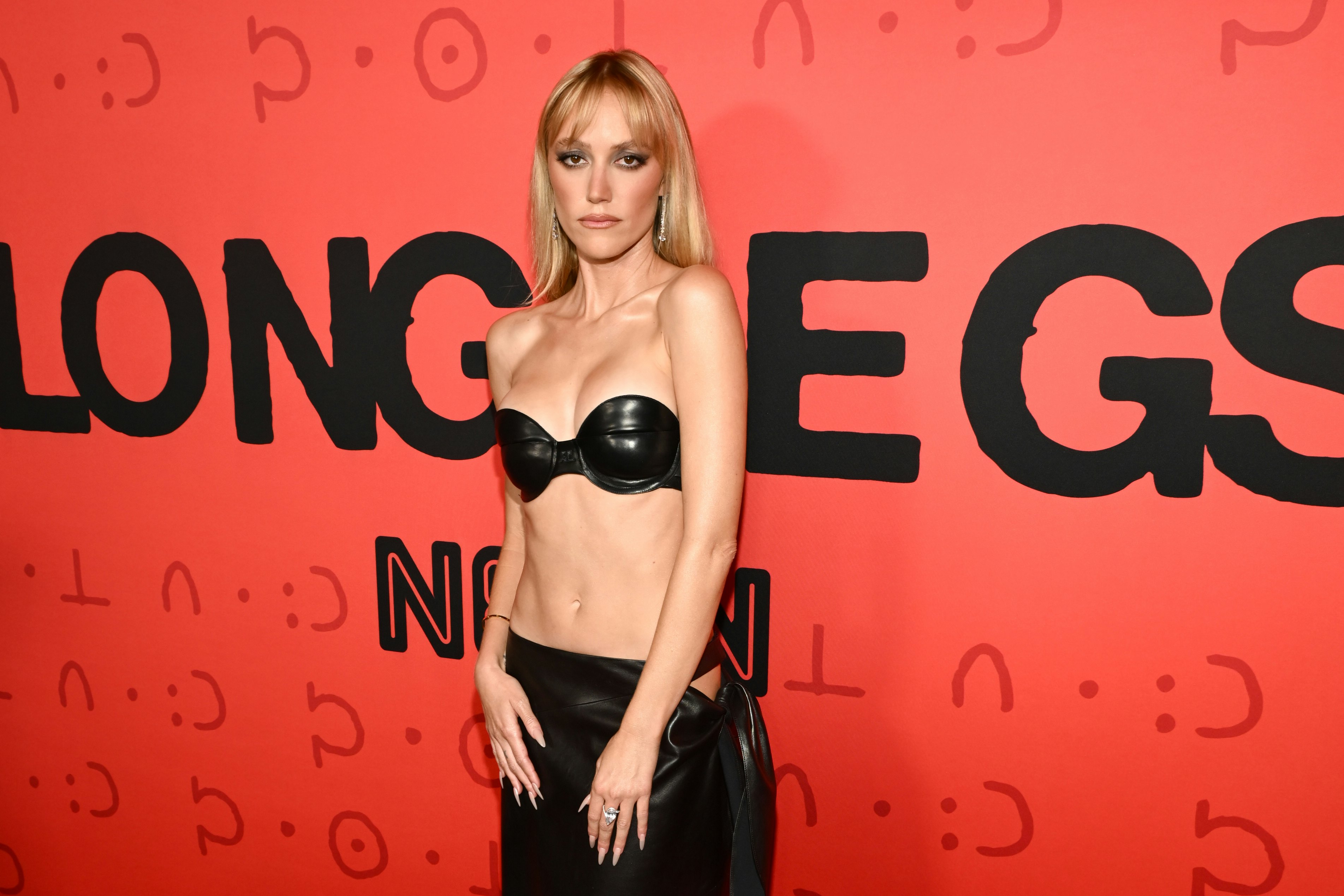
Maika Monroe at the Longlegs premiere. Nylon.

The majority of if not all horror fans refer to the genre as a reflection of culture. Through the themes and scares of each movie, the viewer can see the anxieties, opinions, and concerns of society at the time.


For instance, there was the Red Scare in the 1950s which led to movies like Invasion of the Body Snatchers as people feared what was secretly going on in the minds of those around them, almost like their loved ones had been replaced by evil clones. Early 2000s horror reflected anxieties around our increased use and dependence on technology—in this era, Blair Witch started the found-footage phenomenon and The Ring traumatized any poor person who accidentally found a hidden tape and decided to give it a watch.


However, there is one limit to this “cultural reflection” perspective that goes under acknowledged; the movies only reflect the anxieties of the people making them, and, back then, the people making them were mostly white men. In the late 1970s, the “anxiety” of choice was the disruption of the peace of white suburbia: Halloween, for instance, is about the intrusion of a criminal on Laurie’s neighborhood, which doesn’t feature any people of color, and The Amityville Horror demonized native rituals and traditions by declaring that all of the haunting was happening since their white, suburban home was built on native burial grounds.


What I want to specifically discuss today, however, is the prevalence of sexism in old-school horror. In a recent interview for Variety, actress Maika Monroe commented on the increase in “credible roles” for women in the horror genre, stating: “When I started, horror movies were moving away from hot girl running, covered in blood, to interesting, unique, layered characters and storytelling.” This comment has received a lot of backlash online, mostly by genre fans listing some great female roles from the past few decades and discussing how clueless Monroe is about horror in general.


Personally, I don’t believe her comment is as outlandish as some people are making it out to be.


First, I believe we should acknowledge that the origins of the final girl trope are formed in misogyny. While the term itself refers to its contextually obvious definition (the last girl alive to face the threat at the end of the movie), it carries a lot of baggage to it: the final girl is meant to be virginal, boyish, and shy. She doesn’t put herself out there, and she usually has a love interest boy who dies tragically. She has a great scream, and, most importantly, she’s conventionally attractive. That is all because the final girl wasn’t something that was originated by women. John Carpenter directed Halloween, Wes Craven created Scream and Nightmare on Elm Street, and Tobe Hooper made The Texas Chain Saw Massacre, all movies typically cited as originating the trope.


I’m not saying that to write off all of those movies as sexist schlock—I’m a huge fan of some of them myself—but they are certainly not above criticism.


The “final girl” is not a feminist trope. It rewards women for being the things that men want them to be: sweet, attractive, and virginal. That is why all of the final girls have overtly feminine, bold, sexually-active and often mean friends who die early on. Laurie had Annie, who was known for being the only girl who would go to school without wearing a bra, had a boyfriend, shouted at men in moving cars, and teased Laurie for how “innocent” she was. Sidney had Tatum, who wore bright colors and skirts and not only had a boyfriend, but had a whole rivalry with another girl because she dated said boyfriend in the past. Nightmare had Tina, Texas Chain Saw had Pam, and so on and so forth. These movies punish women for having active sex lives or other “undesirable” traits. The origins of the final girl trope essentially boil down to said character “not being like other girls,” which is especially clear when we remember that these movies are written, directed, produced, and consumed mostly by men.


As much as we might wish they did, horror movies and characters don’t live in a vacuum, and they were created with intention. 


Beyond that, I think Monroe’s original statement was said with more nuance than some commenters seem to think it is. I’m sure that she didn’t mean disrespect to every horror movie that came before 2014 but rather was commenting on something she had seen and experienced herself; she was the one reading scripts for movies and choosing what to do with her life and career, so I think she would know better than me what the majority of horror roles for women looked like at the time.


The response to her statement reminded me of the similar outrage Jasmin Savoy Brown garnered for calling horror “so straight and white” during an interview with Elle in 2023. Genre fans similarly raged at this, pointing toward white, gay male directors making movies like the original Child’s Play. I won’t argue that a lot of franchises like Chucky’s haven’t become more inclusive over time, but it’s impossible to deny that horror was a straight, white genre for quite a while. Lesbianism and transness in particular only tended to be represented in a negative way, with movies like High Tension and Sleepaway Camp demonizing both groups and painting them in a predatory light.


I understand the desire to grow defensive when faced with these claims about horror—we’ve been faced with an endemic of non-horror fans referring to good horror movies as “elevated” or “psychological thrillers,” dismissing their genre because they view them as “too good” to be horror. But instead of dismissing these critiques from genre stars like Monroe and Savoy Brown, we should acknowledge them and use them as a foundation for progress. By recognizing the limitations and biases of past horror films, we can create a more inclusive and diverse genre. This means making room for movies like Longlegs, Scream (2022), Scream VI, and more that invite a broader range of perspectives and experiences. Embracing this change will not only enrich the genre but also ensure that horror remains relevant and resonant for all fans, both old and new.

‘Lowlifes’: Lesbian Cannibals and Backwoods Horror Done Right

In an interesting twist on “eat the rich”, Lowlifes shows the viewer a good time and some class politics you can really sink your teeth into.

Tesh Guttikonda and Mitch Oliver’s Lowlifes was an unexpected blast! Tubi original movies are usually synonymous with cheesy, low-budget, dumb fun, but I thought this movie was a lot better than some of the horror released in the theaters this year. To sell this movie without any spoilers, it’s essentially a clash between two families when one is forced to stay the night at a random house in a small country town. Think Texas Chain Saw meets You’re Next meets The Purge.


It’s better to watch without spoilers, so consider giving it a watch before reading on.


The story kicks off with a seemingly typical family road trip: the nerdy brother, Jeffrey (Josh Zaharia), the edgy sister, Amy (Amanda Fix), the stern father, Keith (Matthew McCaull), and the cautious mother, Kathleen (Elyse Levesque). They encounter Vern (Richard Harmon) and Billy (Ben Sullivan), whom they dismiss as “lowlifes.” When they run into the same men again due to a broken-down car, Keith agrees to drive Billy back to his house, despite Kathleen’s objections.


This kind of moment happens a lot in horror movies, so the viewer is primed to wait in anxious anticipation: what might happen to that visiting family of four? Is Billy going to do anything to them? Tension builds as the moments pass by. However, this is where the movie takes its first wild turn: after Billy realizes something suspicious is going on that even the viewer was unaware of, in one quick motion, Jeffrey kills him, stabbing him in the neck.


The family doesn’t seem to care at all, more annoyed about the bloody mess than anything else. It’s shocking and frightening in a way where it makes you laugh and then wonder why you would be laughing at something so awful. It is revealed that this is a family of cannibals who head out into the remote countryside on a yearly trip to find “nobodies” to kill and eat. Their father pushes this idea that they should only kill people who are supposedly of “no value” to the world, and apparently, to him, those people are lower class townspeople living in the countryside, emphasizing the movie’s focus on class.


The family heads to Billy’s house and is invited to dinner by the welcoming Clearys: Juli Ann (Cassandra Sawtell), Savannah (Brenna Llewellyn), Big Mac (Dayleigh Nelson), and Neville (Kevin McNulty). The movie does a great job balancing out all of these characters; there’s always a believable reason when characters are gone for extended periods of time, and they all have enough defining personalities and characteristics that it’s easy to tell them apart. Tensions rise as the visiting family plots to kill the Clearys. 


While Jeffrey and Keith carry out their plans, Amy finds herself bonding with Savannah, who confides about her life and dreams. Savannah talks about her skill in archery and how her life has always revolved around taking care of her family, but Amy convinces her that she should try taking things for herself. It’s clear that this is advice that Amy herself wants to follow but isn’t sure how to yet, frequently protesting her family’s cannibalism “hobby” but remaining complicit in their actions.


The two girls wind up sharing the bed in Savannah’s rooms (“Do college roommates usually share a bed?”) and having sex. Amy almost attempts to kill Savannah, but ultimately decides not to go through with it because she sympathizes with Savannah’s position of making sacrifices for your family.


After some in-fighting and physical reconciliation, Keith and Kathleen attempt to kill Juli Ann but are interrupted when Savannah shoots an arrow through the window, killing Kathleen.


This sends the whole family into a flux: Jeffery is immediately filled with despair, Keith plans his revenge, and Amy yells at her father for putting them all in danger for the sake of fulfilling his “hobby.” No one seems to pick up on the irony of the situation; they are plotting vengeance against Savannah for acting their mother even though Savannah was only acting to defend her own family.


Savannah attempts to save Juli Ann, but this only results in the both of them being tied up. In order to distract Keith and Amy and give herself time to escape, she reveals that Amy is a lesbian. Keith is enraged by this, and it’s impossible to miss how he refers to her lesbianism as “disgusting” despite the fact that he was trying to feed his hostages the cooked-up pieces of their dead family. Amy boldly declares she’d “rather eat pussy than people,” and Savannah seizes the moment to stab Keith in the eye with a fork, and, in a disgusting turn, he pulls it out and eats it.


Amidst the chaos and gore, the sheriff arrives but misjudges the situation, shooting Savannah because of his offensive preconceptions about her family. The movie ends with Amy killing him, burning the house down, and heading off in her family’s trailer wearing one of the Clearys’ hats: “Ain’t that something,” she says, driving off to freedom.


For a movie with such a low budget, I thought the acting was good—over-the-top in a way that I think matched the slightly humorous tone very well—and so was the writing. It got a bit on-the-nose sometimes in making its points about class, but it made for really comedic moments, so it wasn’t a huge issue for me. Amanda Fix in particular gives a great performance, and I hope to see her in more horror moving forward.


I see the issue with the constant lesbians-are-predatory-murderers content we get, but I felt like this wasn’t particularly egregious despite technically falling into that. In my opinion, it added even more to the class commentary; Keith, who spent the whole movie dehumanizing the Clearys, was quick to reject his daughter’s lesbianism, while Juli Ann explicitly accepted her sister’s sexuality. At the end of the day, I appreciated the nuanced handling of Amy's character and think that it avoided overly predatory stereotypes.


Though I don’t think this movie said anything about class politics that hasn’t been said, I think its message is delivered in such a fun, original package that it’s well worth the watch anyway.


★★★
7.5 out of 10
You can stream Lowlifes on Tubi today!


Saturday, July 13, 2024

‘A Quiet Place: Day One’: A Mixed Bag of Heart and Horror

Lupita Nyong’o single-handedly breathes life into an otherwise tame horror feature in ‘A Quiet Place: Day One'.


Last night, I had the pleasure of watching A Quiet Place: Day One for my birthday. While I surprisingly have not seen the past two entries in the franchise, I checked this one out on account of Lupita Nyong’o and Lupita Nyong’o alone since I’ve loved her other ventures in the horror genre. As a preemptive warning, this discussion will include spoilers!

In this movie, Sam is a woman in hospice with cancer, essentially just waiting for death. Her nurse, Reuben (Alex Wolff), insists on taking her and the other patients to a marionette show in New York City with the promise of stopping for pizza on the way back. It is while they are in the city that the aliens come down from the sky, leaving Sam and her cat to navigate the remains of a silent city, trying to fulfill the ultimate goal of her trip by getting some pizza. Eric (Joseph Quinn), is a law student who eventually joins her on the trip who is determined to help her and learn to live a little himself.

Going in, I will admit that I tend to be slightly biased against PG-13 horror movies. It’s not necessarily because I don’t think a good story can be told in the PG-13 format but simply that it is harder to believe in the stakes. While there is something to be said about the way Sam’s (Lupita Nyong’o) friends are plucked off of the street in the same way a big bird sweeps in for its prey, I don’t think this necessarily did anything to make up for that loss of tension.

There were many scenes in the movie where I could see the potential for something to be scary that lacked follow through. For instance, at one point in the film, Eric has ventured into what seems to be a nest or home of some sort for the alien creatures, and he comes across strange objects that seem to resemble eggs, but I noticed that they seemed to be made up of human hair/viscera. My friend who I had watched with was watching the movie for the second time and didn’t notice this until I pointed it out. I think the idea that the monsters could be taking the humans and almost digesting them in a way — breaking down their bodies — to make into these eggs that produce real food for them is probably one of the most horrifying ideas presented in the movie, but it was only briefly hinted at, and by briefly, I mean briefly.

Moments like this are where I feel like the PG-13 rating brings down a movie; if these pods were slightly more detailed or grotesque or even if we spent more time exploring what exactly they were, the idea would have been communicated more efficiently in a more harrowing way, à la Nope’s famous digestion scene.

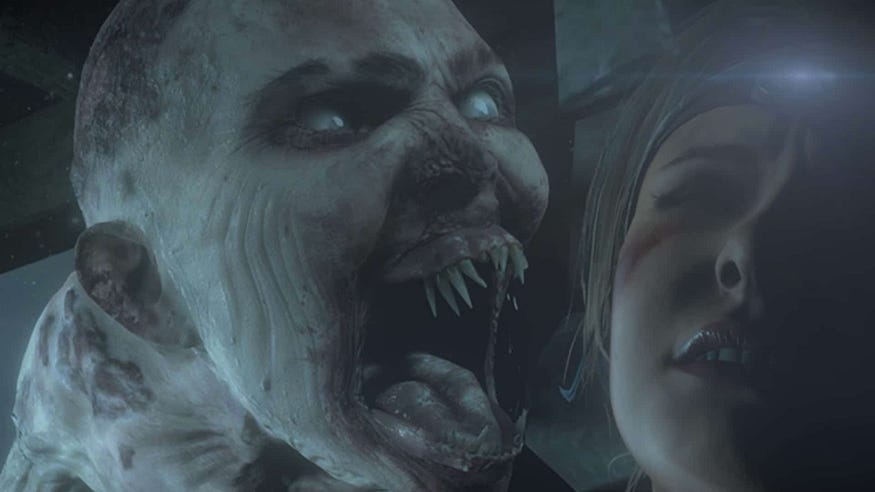
To be totally honest, I don’t think this movie was really trying to be “scary” at all. Aside from a couple cheesy jumpscares thrown in there for poorly conceived shock value and a few scenes that seemed like they were ripped straight from the 2015 video game Until Dawn, being horrifying or making the viewer uncomfortable was definitely not the goal of this movie.

A still of a monster screaming in a character’s face from the game Until Dawn.

The film focused almost entirely on the story between Sam and Eric — Sam is someone who had given up on living because she knew she was going to die, and Eric was someone who had never lived for himself. I honestly got the impression that Eric was depressed, guided by his father on a path he had no interest in, and I learned that rumors confirmed he was originally intended to be suicidal but this was later cut from the movie. I think that keeping this detail could have added an additional, more inspiring layer to this movie’s ending without adding much to the film’s quick 99 minute runtime.

That’s not to say that I didn’t love the movie’s ending as is. I thought it subverted what is sadly a common trope where the Black character sacrifices themselves to save a white character’s life by having her survive her sacrifice, as unrealistic as that might have been. She’s smart, and at the end of the day, she gets to end things on her own terms, listening to the music that brought her so much joy in her childhood and comfort during her time in hospice rather than simply waiting for death. The way I interpret the movie, she would have stayed in the city regardless, with the only exception being her getting on the boat simply to save her father’s jacket and her cat. Her emotional arc including her experiencing that “final time in the city” she had always dreamed of and learning to really live in her last moments was very heartwarming and heartbreaking at the same time.

In a way, I think this movie would have been better if it hadn’t shoehorned in so much “horror.” Don’t get me wrong — I love horror, and it’s my favorite genre of all time — but I feel like the scary parts of this movie were by far the weakest and most underdeveloped. I won’t get into the technicalities of the monsters’ ability to discern sound (though I will say I’m not sure I understand why a. they don’t end up attacking each other more often and b. a shirt ripping was loud enough to get their attention but Sam and Eric repeatedly dropping things wasn’t), but almost every jumpscare felt forced. One particularly egregious instance included a probably 10-second dream sequence ending with a monster jumping through the window. This scene didn’t add anything to the movie, and it followed a moment of levity rather than one of tension, so it didn’t even serve as a release in that way. I felt this was the case for a lot of the jumpscares.

I also expected to be more blown away by the sound design. That’s not to say that it was bad by any stretch because it definitely wasn’t, but it didn’t feel like you had to see this in the theater to get the full experience, almost like it was designed to be sent off to streaming. I understand catering to streaming to a certain extent, but I do feel like sound is the one thing that theaters can and consistently do better, and for a franchise so tied up in sound, I’m not sure why this wasn’t spectacular.

The sound only negatively stood out to me most during a scene where Eric was attempting to retrieve medicine for Sam. It was an inexplicably silent scene; while I understand that the world around them is always silent, there was usually music in the background, or at least generic city breeze and things like that. The silence seemed jarring, and by the end of the scene, it was clear they had only done this to build tension for another fake out jumpscare. The silent cityscape could have been something interesting to explore, but since they weren’t as committed to that through the rest of the movie (which is fair; music really does help explain emotional cues when faced with silent protagonists), it just felt out of nowhere in that scene.

Nyong’o gave a standout performance as Sam. She had a sort of emotional honesty in the role that I believe would be difficult to replicate and was essential in getting the audience to buy the premise of the movie without the physical stakes that might have been there in an R-rated movie with more violence, scares, and gore. She made the story aspect of the movie aside from the horror work in a way that I’m not sure would’ve worked otherwise. I suppose Quinn was an adequate supporter, but I’m not sure there is much to say beyond that. I didn’t particularly enjoy his performance, but in all honesty, besides the lore I was trying to invent for him in my head, the character didn’t give him much to work with.

Overall, I don’t think this movie delivered on the horror part of its premise, though I did cry at the ending, so it couldn’t have been too bad.

★★★☆☆
6.9 out of 10
Go see A Quiet Place: Day One in theaters today!

'Opus' and the "Don't Worry Darling, Get Out!" Phenomenon

Opus is a movie with an identity crisis, but that's not because of its central conflict. To start this review, I want to address the “D...